Thursday, November 28, 2019

Proof of Burn (PoB)

Proof of Burn (PoB) is a consensus algorithm where "miners" send coins to public addresses that have been randomly generated to become inaccessible and unusable.
By sending the coins to a public address that inaccessible they demonstrate commitment to the network and as such gain the ability to "mine" the next block and validate the transaction. This "mining power" is accumulated as the user burns more and more coins thus increasing the likelihood of being chosen as the next block validator and being rewarded for validating the block.
The reward for validating a block is dependent on the cryptocurrency in question much like PoW or PoS it can awarded at certain intervals but typically the reward covers the amount of coin burned. This virtual mining displaces the actual need for mining hardware found in the Proof of Work (or PoW) blockchains as they are energy inefficient. This accumulation of the cryptocurrency is also similar to Proof of Stake (or PoS) as large holders can burn more tokens thus increasing the likelihood of being chosen as a block validator.
Burnt coins over time begin to "decay" in which the amount burned becomes less and less valuable requiring periodic investment in order to maintain the same level "mining power." This prevents early adopters from dominating the network and incentivizes adoption as it is still viable to participate later in the cryptocurrency.
An additional benefit of removing cryptocurrency from circulation is that it promotes scarcity which in turn creates economic scarcity which can drive the value of the cryptocurrency up. Depending upon the cryptocurrency the coin burned can be the native token, or another more popular cryptocurrency.
The underlying result is the same, something valuable must be expended in order to be rewarded which encourages long term commitment from miners and focuses on decentralization away from computational hardware mining. Typically Proof of Burn is used as a part of in conjunction with other blockchain consensus methods such as Proof of Work or Proof of Stake.
The most common example of PoB would be to remove unspent Initial Coin Offering (ICO) tokens from circulation. This has the benefit of typically raising the price of investors' tokens by restricting the supply further as well as removing the question of what is being done with unsold tokens.
However, Proof of Burn is not without it's own host of disadvantages such as it's relatively recent introduction to blockchain consensus it is still unproven at large scales which means that it's no real world results on it's actual security or efficiency. The process for burning of coin is also rather opaque for the average user, although a user could verify that a burn has taken place on the blockchain usually through an explorer it is difficult to quantify burns across the network unlike PoW which follows hashes or PoS which is typically dictated by wallet sizes.
Another issue that plagues PoB is verification of work (the burning itself) is often delayed because it lacks the speed of PoW or even PoS as the transaction needs to be confirmed before the block can be validated and the work confirmed.

Digital Signatures

Digital signatures are the digital version of handwritten signatures on paper documents. The goal of both kind of signatures is to provide authenticity and to grant that a document or set of data has not been altered on its way from the sender to the recipient (integrity). Digital signatures provide these security measures by using asymmetric cryptography. In contrast to handwritten signatures, that are always the same, digital signatures are unique and differ according to the message that is transmitted.

Hash functions

The main components of digital signatures are hash functions. By using specific algorithms they transform data of any kind and size into a fixed output size. This process is called hashing. As already mentioned they transform arbitrary sized data and transform them into a fix-sized output. These output values are called hashes. Sometimes they are also referred to as hash values, hash codes or digests.
Combining hash functions with cryptography leads to unique digital signatures. Cryptographic hashing, as it is called. Changing the slightest aspect of a message would result in a totally different hash value.
In general we distinguish symmetrical and asymmetrical cryptography schemes. As asymmetrical cryptography is the wider used and more secure way to encrypt messages we will take a closer look at that one.

Asymmetric Cryptography

Asymmetric cryptography, also known as public key cryptography (PKC), uses pairs of keys to encrypt and decrypt messages. Thereby public and private keys are created. As their names already tell, the private key should be kept secure and private while the public key can be spread publicly.
The two main use cases of asymmetric cryptography are digital signatures and the public key encryption. As the latter already suggests, public key encryption uses the public key of the sender to encrypt a message. The message can then only be decrypted by the recipient of the message if he or she is in possession of the corresponding private key. Digital signatures in contrast use the private key of the sender to encrypt the message. Here anybody with access to the corresponding public key is able to decrypt and read the message.

Functionality of digital signatures

In general the digital signature process consists of three main steps or algorithms: key generation, signing and verifying.
The key generation or hashing process runs an algorithm on the data that needs to be signed. The algorithm selects a uniform private key that is randomly chosen from a set of possible keys. The output consists of the private key and a corresponding public key.
The private key in addition with the message data is used as input for the signing algorithm. Both public and private key are provided by the sender of the message. If the public key is not provided in transmitted data the recipient won’t be able to decrypt it.
If the recipient has access to the public key he or she will not only be able to decrypt the message but will also be able to verify the authenticity of that message. The message will have to be encrypted by the senders private key. As he or she is the only one with that key (that’s what we assume) only the corresponding public key will be able to encrypt it.

Goals of digital signatures

  • Data integrity makes sure the content of the message has not been altered on its way from sender to recipient
  • Data authentication makes sure the recipient can make sure the message came from the sender and nobody else
  • Non-repudiation makes it impossible for the sender to deny he or she sent this message

Challenges

The quality of the hash function and cryptographic scheme is crucial for the security of the message. If poor or easy to decode hash functions or algorithms are used it’s easier for hackers to decrypt the message without having access to the corresponding key. Same goes for the implementation of those functions. Even if good algorithms are used, they also have to be implemented and used properly in order to secure the encryption and decryption of the message. The last challenge of digital signatures is the private key. If this key in not kept safe and gets compromised or leaks this can result in huge security issues. For cryptocurrency holders the loss of a private key can lead to big financial losses.

Technical Analysis (TA)

Technical Analysis (TA) is a term used in finance referring to a forecasting method that tries to predict future price and market movements by analyzing market data from the past, mostly price and volume. TA is commonly used on any security, including stocks, futures, (crypto-)currencies, commodities or fixed-income. The only prerequisite here is that historical data is available that can be analyzed.
While the Technical Analysis focuses mostly on recognizing patterns in price movements and recognizing trends, Fundamental Analysis tries to figure out a securities intrinsic value by also evaluating the general economy, earnings, expenses, assets, liabilities and many more.

Main principles of TA

Market discounts everything
According to the Technical Analysis all information regarding fundamental data is already included in and reflected by the current price and can therefore be ignored. The goal here is to understand how other people interpret this information and to analyze the price movements (supply and demand).
Prices move in trends
Probably the most important believe in TA is the assumption that prices move in patterns or trends. This includes short-, medium- and long-term trends. According to this principle it’s much more probable for a price to follow an already started pattern than to break out of it.
History repeats itself
As TA is mostly based on market psychology, the last principle states that history repeats itself. In detail the principle claims that price movements and patterns repeat themselves over a long period of time. It is based on the irrational emotions of investors created by fear or excitement.
In summary TA focuses mostly on the market forces supply and demand. As market data becomes more and more complex traders usually use statistical and mathematical approaches to create indicators to act upon.

Indicators

Traders using TA try to forecast future price movements. Indicators to recognize those include chart patterns, price trends, volume and momentum indicators, oscillators, moving averages and support and resistance levels to name the most common ones. TA indicators are commonly used to create buy and sell signals for traders to act on. Especially in recent years with the rise of Artificial Intelligence (AI) these indicators gain importance as they deliver statistical data that can be interpreted and used by trading algorithms.

Limitations

Especially in the cryptocurrency sector TA has big limitations. First of all the low volumes and market caps of most projects can lead to high volatile markets that can easily be manipulated by a single investor. Secondly the data available to use for that kind of analysis is usually little and doesn’t reach back far enough to recognize long term trends. Finally most of the assets in a currency are still held by few investors which gives them the opportunity to manipulate prices and volumes.
Looking at general security markets TA sometimes creates a self fulfilling prophecy. A lot of TA traders will put their buy and sell orders according to the patterns they start to recognize. The more traders act like that the higher is the probability that this pattern will show up in the end as many traders will act according to it already.

Monday, November 25, 2019

COMPOUND INTEREST

Compounding, usually refers to the rise in value of an asset from interest earned on the initial principle down with accumulated interest over time. Resulting in a time & asset evaluation, also known as Compound Interest. While compound Interest increases the value of an asset more passively, On the opposite, a loan can cause a negative interest effect on a individual who decides to take a loan.
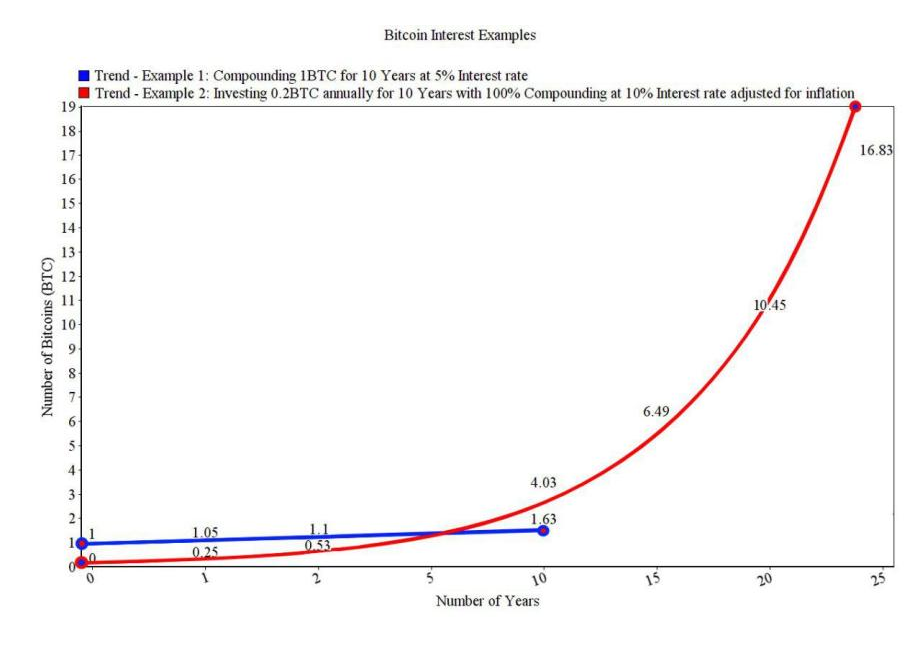
To explain how compounding provides incentive to holding long, lets say 1 BTC is held in a wallet that pays 5% interest annually. After the first year, the total balance in the wallet has gained up to 1.05 BTC, a reflection of 0.05 BTC in interest added to the 1 BTC principle, the wallet gains 5% growth on the original principal (1 BTC) and the 0.05 BTC of first year interest, resulting in a second year gain of 0.0525 BTC and a balance of 1.125 BTC after the first 2 years. As long as no withdrawals take place, and a steady 5% interest return remains. The wallet balance would grow to 1.625 BTC in 10 years, creating a steeper compound curve with time and value.
Here is a curve chart drawing, showing a alternative basic method of compounding over time. Resulting in significant growth.
compound interest stakecube
With the above example you may see that holding an asset long, pays a bigger return over time. The longer you may hold the better in most cases. This is of course subject to risks, companies may go bankrupt, houses catch on fire, and nothing is fail proof. The risk must be considered, and is apart of the equation and evaluation of a long term held asset, each sector has a basket of risks included.
Compounding has been around for hundreds of years. As time moves along, and technology evolves, the common person has access and more options in relation to compounding investments. In example, things like real estate, dividend stocks, and verifying crypto transactions are currently some of the most popular selections.
Another example of compound interest is called income investing, usually offering some sort of return on investments also known as ROI. Historically these type of investors find a way to use the income generated from one asset, to supply funds to put into another income investment. Resulting in a diversified portfolio and more than one stream of income from your investments. This also helps balance risk. When diversified properly between sectors, one asset may be down in market evaluation, while another asset, from a different sector, may be up in market value. This creates a more balanced approach, along with more flexibility, also eliminates a layer of risk involved like holding all eggs in one basket as a example.
Compound Interest, income investments, and alternative cash flow sources of income can help create financial independence, establishing a nice form of retirement pensions, and provide a long term growth portfolio. Enabling the normal person the opportunity to have financial freedom. Compounding creates a way to have a passive income with out doing any back breaking work.

DELEGATED PROOF OF STAKE (DPoS)

Delegated Proof of Stake (DPoS for short) is a blockchain consensus designed with maximum decentralization and engaged users.
It was created as a direct response to the energy use of Proof of Work (PoW) cryptocurrencies and their tendency toward centralization. Users use their stake of coin to vote for Witnesses and Delegates (Some cryptocurrencies have one or the other or both) that govern the blockchain.
Witnesses essentially are trusted validators of transactions that as awarded for every transaction. This also creates network stability as missed blocks are automatically processed by the next Witness. Witnesses cannot change the content of transactions, and any malicious behavior is immediately handled by voting the Witness out of the position. If a Witness proves to be a unreliable validator and not having stable uptime, they can also be voted out of their position. Waiting in the wings are a large group (usually without limit) of backup witnesses looking to step into the limited active Witness slots to ensure the network continues to transact without instability. Backup witnesses are also compensated but at a much reduced rate than Active Witnesses.
Meanwhile Delegates are voted into power the same way Witnesses are however they are not responsible for validating transactions (and thus not paid) but instead are responsible for pushing changes to the blockchain covering things like transaction fees, witness pay, block intervals, block sizes, and other network conditions.
When a change is proposed by delegates, the network is allowed to vote on the changes to the network and the delegates themselves. The voting ensures that both Delegates and Witnesses are incentivized to act in the best interest of the network or risk reputational or financial loss. This makes DPoS unique in that every user's voice can be heard through the voting process when witnesses and delegates validate or change the network.
Unlike PoW where small miners cannot affect the network unless they gather together in large pools of miners which leads to further centralization of consensus and makes the network far less secure.
PoS likewise excludes the smallest of stakeholders from influencing network changes unless you reach a certain threshold which is largely undemocratic.

Thursday, November 14, 2019

Proof of Stake

Proof of Stake (short-handed to PoS) is a blockchain consensus method originally intended to create an alternative to Proof of Work (PoW) which uses intense computation of mathematical puzzles to validate transactions and draft new blocks. Staking allows miners (known as Stakers) to create a fully distributed blockchain based around the random selection and length of time of a locked set of coins known as the Stake to validate transactions and create new blocks, rewarding users for holding coins in their wallets at predictable if somewhat random rate.
Another benefit of PoS over PoW is that it is energy efficient, only using enough energy to run the wallet software and the network connection to it instead of high intensity mining hardware designed to compute the puzzles that validate transactions in PoW. PoS only allows the staker to gain a percentage of the total amount of coins staking at that moment. For example, if you stake 10 coins and the total network has 100 coins staking then you would be rewarded for approximately 10% of the transactions in the network. The specifics of the amount rewarded differs from cryptocurrency to cryptocurrency, some coins will have an escalating series of rewards based on the block height (number of blocks transacted) whereas some coins will have a fixed interval over the life of the network. This creates a predictable rate of interest for the staker as well as the inflation rate of the coin as the network ages and gains maturity making it a popular choice for users who want long term cryptocurrencies that they can hold and help incentivize securing the network.
Additionally, because it is possible for even the smallest (although statistically unlikely) stakes to generate rewards this creates a much more egalitarian and fair distribution model as more participants in the network can be incentivized, this creates a stronger, more decentralized, and secure network. This is especially when compared to other consensus algorithms such as PoW where large spikes in mining difficulty can effectively remove small miners from the network due to infrastructure costs of running mining equipment far outweigh the ability of miners to generate revenue.
However Proof of Stake isn't without it's criticisms, many experts on blockchain argue that PoS creates an incentive for "Fake Stake" attacks in which poorly written or secured code can have negative repercussions on the network by allowing bad actors to essentially fake the size of their stake to generate rewards.
Another criticism of PoS is the inflexibility of transacting coins when staked in a wallet, unlike PoW where puzzles are solved by dedicated hardware and coins can transact freely. PoS requires coins to be locked often for long periods of time in order to generate rewards for the user for validating transactions. This has the plus side of making the network and often the price very stable but often at the expense of market volume and liquidity.
Delegated Proof of Stake (known as DPoS) attempts to address some of these concerns by adopting a model of trusted nodes called "Witnesses" that help secure the network from bad actors.

Wednesday, November 13, 2019

STAKECUBE - the shared masternode and POS pool

POS or Proof of Stake coins are growing more and more popular but a lot of people cannot afford to own enough coins to get a reasonable return or own their own Masternode. For the uninitiated, POS is where you hold your coins in wallet and 'stake' them and receive extra coins as a result. This can be quite profitable, but of course the value of a coin can itself decline as well as go up.
StakeCube is a POS Pool, probably the most user-friendly of all of them and have some unique POS pool benefits for being early adopters.
The benefits of staking in a pool is that you do not have to keep lots of wallets open 24/7 saving on electricity and you can benefit from higher rewards than if you staked alone. You can even stake small amounts of coins and benefit from being in a large pool.
You don't have any coin to stake? No problem, there is faucet features in StakeCube that you can claim some coins and automatically staking after your claims.
StakeCube taking 3% fee (from Stake profits - you never pay anything to them) and 1% for airdrops and lottery. Everyone will get an airdrop of all coins, even coins you don't hold and you can then stake these. You can see the compounding benefits of this.
The GUI / User interface is absolutely superb with all the information you would want, and literally everything is transparent and can be followed on the Blockchain. You can see what percentage of each pool you own. You can withdraw your coins at any time and with zero fees.
To deposit coins you simply click on the coin name and an in-browser window pops up with a deposit address as well as lots of other useful info about the coin including which exchanges support these coins - that's important as lots of POS coins are quite small and will not be on the larger exchanges. Any coins you do deposit can also be added to a pool Masternode for greater returns.
There are more than 40 coins listed on Stakecube.
And wait!! 
Besides staking and masternode rewards, there are also interest paying out for BTC, DOGE, LTC and DASH for 7.0++% interest annually. This means, you will get around 0.02% of interest of the coins in your StakeCube Wallet.
StakeCube has its own exchange platform. You can exchange your coins on the platform.