Thursday, February 24, 2022

Free Crypto from Faucetpay


If you are looking to earn cryptocurrency for free, there’s a site that claims you can do so by doing simple tasks. It’s called FaucetPay.

But is FaucetPay even legit and worth joining or a scam to stay away from?

Well, this FaucetPay review will answer that and all other burning questions about this site.

You will get an inside look and learn about all the details and know exactly what to expect and if this is really worth investing your time in or not.

Join now

What is FaucetPay and what does it offer?

FaucetPay is mainly a micro wallet that also has Get-Paid-To (GPT) features, which makes it quite a unique site. But for the purpose of this review, we will be looking at the GPT aspect of the site. As for its legitimacy, FaucetPay is indeed a legit site since it will really pay you for completing simple tasks.

Now, to fully understand how this site works, we have to take a closer look at the earning opportunities it offers. By doing so, you can also get a snapshot of how well you can earn from this site.

I have, therefore, made a video that gives you an inside look and shows exactly how you can earn from FaucetPay. You can also read all the details below the video.

Join now

Option 1 – Paid surveys

When you become a member of FaucetPay, the first earning opportunity that will be accessible to you is their paid surveys. The reason why I say it is the first accessible opportunity is, the other earning opportunities need to be unlocked (I will explain later how to unlock them).

Take note though that the paid surveys I’m referring to here are the paid surveys from one of their partner sites (TimeBucks). Their actual paid survey section has to be unlocked like their other earning opportunities.

To access their paid surveys from TimeBucks, you just have to log in to the site and click the “Earn” option on their menu. Then, click the Offerwalls. Under the Offerwalls section, you have to click TimeBucks. You will then see something similar to the photo above.

Just choose which survey you want to answer and then click the “Answer” button. It will open a new browser tab where you will have to set up your profile first. Just answer all the profile questions as honestly as you can. Once you are done, you will be notified if there are surveys available for you.

If there is a survey available, then just proceed with answering it. Once you finish answering the survey, you will receive the reward promised. If there are no surveys available for you, then you just have to go to the next available survey in the FaucetPay offerwall.

For every survey you complete, you will be rewarded with USDP. Later on, I will discuss what you can do with the USDP you’ve earned.

Join now

Option 2 – Daily login bonus

Once a day, you will be able to claim a login bonus. The first time you log in to the site for the day, you will immediately see something like the photo shown below.

During your first day, the daily login bonus will be set to 1 Reward Point. This will gradually increase when you keep your streak of logging in to the site. The maximum Reward Point you will get will be 100 Reward Points.

So say for example, you’ve logged in to the site for 15 days straight and the last bonus you got was 15 Reward Points. Then, the next day, you failed to log in, thus stopping your streak. The next time you log in to the site, the daily login bonus you will receive will be back to 1 Reward Point.

That’s why it is really important to keep the login streak going to maximize your earnings. To give you a perspective of how important this bonus is, 1 Reward Point is equivalent to 1 Satoshi. So, you can potentially earn 100 Satoshis every day you log in, which is a nice bonus, in my opinion.

Join now

Option 3 – Offerwalls

This is another earning opportunity you have to unlock. You can only access their offerwalls if you have made a certain number of faucet payments per month (usually 5 to 7 faucet payments). So, how do you get faucet payments?

Well, the first thing you do is sign up to a website or app that dispenses rewards in the form of Satoshi (the smallest unit of a Bitcoin). In other words, you have to look for other GPT sites and apps that give out Satoshis as payment through a faucet.

Then, you have to link that faucet to your FaucetPay account (refer to the photo above). Once you’ve linked that, you just have to do the tasks offered by those other sites and apps to get paid. I know, it’s kind of a weird setup because you will have to work on other sites and apps.

But, if you want to unlock their offerwalls, you have to comply with this requirement. Now, if you’re not familiar with offerwalls, they are basically in-site/app advertising platforms that are designed to promote websites and mobile apps.

Offerwalls do this through their paid offers. These paid offers are simple tasks you can do to earn rewards. These tasks will usually ask you to answer surveys or quizzes, play mobile games, sign up for websites, watch videos or ads, and more.

To work on a paid offer, just choose which offerwall you want to work on and click it. Then, click the offer you are interested in doing. You will then see the instructions you have to follow to complete the offer. Make sure to read and understand the instructions before you start because if you miss even just one step, you will not be able to complete the offer and you won’t get paid.

When I was doing my testing, FaucetPay had 8 offerwalls available, which isn’t that many compared to other GPT sites. So, there aren’t a lot of offers you can do and you will eventually run out of things to do to earn from. That’s one of the disadvantages of this site. But, you can still work on the other opportunities to earn more.

Join now

Option 4 – FEY staking

Speaking of other opportunities, you can also earn by participating in their FEY staking. If you’ve been working with cryptocurrency for a long time, this will be very familiar to you. But if this is your first time hearing about the term “staking”, it’s a form of earning opportunity where you can earn cryptocurrency by depositing a certain amount for a specific period.

In FaucetPay’s case, the lock-in period for their staking is 70 days and it will involve the token called FEY (or Feyorra). So, how can you get this token? Well, you can use any cryptocurrency to trade for this token. And the good thing is, you can just do it inside FaucetPay since they have a trading platform you can use.

For example, you can convert your Bitcoin to FEY tokens. That’s usually the route members take when they want to participate in the staking. Once you’ve converted your Bitcoin to FEY tokens, then you just have to choose the kind of staking you want to participate in.

I would suggest you join the one that is almost close to full so that you don’t have to wait long for the staking period to start. Once it starts, you just have to wait 70 days to receive your reward. It kind of works like putting money in the bank and waiting for the interest to be credited to your account.

Take note that the FEY token you’ve placed in staking can’t be withdrawn until the staking period is over. Before you decide to participate in this earning opportunity, I would suggest you read up first on what crypto staking is really all about.

Because you can also potentially end up losing money by doing this and you need to know exactly what you are getting into.

Join now

Option 5 – Multiply BTC games

FaucetPay has a section called Multiply BTC.

This is a section where you can potentially multiply your earnings. However, this also comes with a risk.

You can bet your earnings and it offers several games where you can do this. At the time of writing this review, the games you can play are Dice, Roulette, Limbo, Crashes, and Plinko.

All of the games are very simple and easy to play and they have easy-to-follow instructions on the website. You just choose a bet and play the game and if you win, you will get a reward but if you lose, you will lose your bet.

The higher amount you bet, the more you can potentially win, but then, of course, the risks will also be higher.

So this is not a good option for all and only a good option if you like gambling – but be careful as your earnings can quickly disappear if you are not lucky.

Join now

Option 6 – Referral program

Lastly, you can earn bonus rewards by participating in their referral program. If you are not familiar with what a referral program is, it is basically an opportunity where you can earn by inviting other people to join the site.

All you have to do is share your invite link with the person you want to invite and once they sign up to FaucetPay using your link, they will become your referral.

But, before you can earn from their referral program, your referral must become an active member of the site. That means they have to complete any of the earning opportunities offered by FaucetPay. For example, if they complete a paid offer from one of their offerwalls, you will receive a 25% commission which will be shouldered by FaucetPay.

Join now

So, make sure to invite people that are really interested in earning from FaucetPay.

Introduction to Options

What is an Option?

 Options are not to be confused with futures, as they are two separate financial instruments.

The option seller has the corresponding obligation to fulfill the transaction – to sell or buy – if the buyer (owner) ‘exercises’ the option. The underlying asset/instrument could be a stock, bond, foreign currency, commodity, or any other traded instrument. Exercising means utilising the right to buy or sell the underlying security. 

Usually, an option contract should include the following specifications:

Type: whether the option holder has the right to buy (a call option) or the right to sell (a put option).

  • Underlying asset and  quantity: the quantity and the underlying asset(s) (e.g.: 100 shares of Apple.Inc stock)
  • Strike price: the stated price where the buyer will exercise the option
  • Expiry date: the last date the option can be exercised
  • Settlement terms: for instance, whether the option seller (writer) must deliver the actual asset on exercise, or whether he/she will simply tender the equivalent cash amount
  • Option premium: the total amount you pay for the option.


Why Use Options?

There are two types of options: Call and Put. Call options allow the owner to buy a specified amount of underlying asset at a fixed price within a specific period of time while put options allow the holder to sell a specified amount of underlying asset at the strike price within a specific timeframe.

An option can also be categorised by American or European style. American options can be exercised any time before the expiration date of the option, while European options can only be exercised on the expiration date. When you buy an option, the purchase price is called the premium. If you sell your option, the premium is the amount you receive. The premium isn’t fixed and may fluctuate based on market conditions. 

Aside from providing investors with the right to buy or sell underlying assets, there are various use cases for options1:

Versatile securities

The advantage of options is that you are not limited to making a profit only when the market goes up. Because of the versatile nature of options, you can also make money when the market goes down or even when it moves sideways.

Speculation

If you buy an options contract, you are betting on the movement of the security. This kind of bet requires extensive knowledge of financial markets and a high risk tolerance.

Hedging

Options are used as an insurance policy to protect your stocks against a potential downturn.

Options to attract employees

Many companies use stock options as a way to attract and keep talented employees.

Different Types of Options

As mentioned before, the strike price for an option is the price at which the underlying asset is bought or sold if the option is exercised. The relationship between the strike price and the actual price of a stock determines, in the unique language of options, whether the option is in-the-money (ITM), at-the-money (ATM) or out-of-the-money (OTM)2.


In the money (ITM)

For call options, in-the-money means that strike price is below the actual stock price. 

Example: An investor purchases a call option at the $95 strike price for XYZ that is currently trading at $10. The investor’s position is in the money by $5. The call option gives the investor the right to buy the equity at $95. 

For put options, in-the-money means that strike price is above the actual stock price. 

Example: An investor purchases a put option at the $110 strike price for XYZ that is currently trading at $100. This investor position is in-the-money by $10. The put option gives the investor the right to sell the equity at $110.

At the money (ATM)

For both put and call options, the strike and the actual stock prices are the same.

Out-of-the-money (OTM) 

An out-of-the-money call option strike price is above the actual stock price. 

Example: An investor purchases an out-of-the-money call option at the strike price of $110 for XYZ that is currently trading at $100. This investor’s position is out-of-the-money by $10. An out-of-the-money put option strike price is below the actual stock price. 

Example: An investor purchases an out-of-the-money put option at the strike price of $95 for XYZ that is currently trading at $100. This investor’s position is out of the money by $5.

Payoff

You have now familiarised yourself with option basics. Now, let’s take a look at how option works and how the payoff can be derived. Payoff diagrams are charts that illustrate the profit/loss of the option as its underlying price changes, and the conditions include: long-call, short-call, long-put, and short-put.

Long-Call

Bob is bullish on Apple Inc. because he believes the new iPhone will have more functions and  will subsequently give the stock a good bump. Rather than buying shares, Bob is looking at a long position with call options, as they limit his downside while  still allowing unlimited gains if the stock price blows up. Here are some facts about his position and what the payoff will look like at various stock prices:

Given: option premium per share = $2, option strike price=$100

The breakeven point is the stock price at which an investor’s net profit will be zero:

Breakeven stock price = Strike price + premium

In this case, the breakeven price is $100 + $2 = $102. Another feature to note is that if the stock price is below the strike price, Bob will just let the options expire without using them and his losses will be limited to the premium he paid for the options. On the other hand, the profits are unlimited as the price goes higher than $102. 

Here is a formula:

Call payoff per share = MAX (stock price – strike price, 0) – premium per share

At a stock price of $98, MAX ($98 – $100, 0) – $2 = 0 – $2 = $2 per share loss

At a stock price of $105, MAX ($105 – $100, 0) – $2 = $5 – $2 = $3 profit per share

Short-Call

The writer (seller) of the call option takes a short or opposite position. His payoff graph is the opposite of the long-call we mentioned. Profits are limited to the premium he collects when the strike price exceeds the stock price and the calls are allowed to lapse. Above the strike price he faces increasing losses as the stock price increases. 

The payoff formula is:

Short call payoff per share = premium per share – MAX (0, share price – strike price)

Long-Put

In this circumstance, Bob is bearish on Apple.Inc stock as he feels that the new iPhone may be overhyped due to public anticipation. He might therefore buy a long-put option of Apple stock, through which he gains interest as long as the stock price drops below the breakeven price. His loss is also limited to the paid premium and the gain can reach a maximum when the stock price drops to 0.

Given: option premium per share = $2, option strike price=$100

Breakeven stock price = Strike price – Premium

In this case, the breakeven price is $100 – $2 = $98. If the stock price is above the strike price, Bob will just let the options expire without using them and his losses will be limited to the premium he paid for the options. On the other hand, his profits are also limited as the price can go lower than $98 and reach the maximum when the price is zero. 

Here is a formula:

Put payoff per share = MAX (strike price – stock price, 0) – premium per share

At a stock price of $103, MAX ($100 – $103, 0) – $2 = 0 – $2 = $2 per share loss

At a stock price of $95, MAX ($100 – $95, 0) – $2 = $5 – $2 = $3 profit per share

Short-Put

The writer (seller) of the put option takes a short or opposite position. His payoff graph is the opposite of the long-put position illustrated above. Profits are limited to the premium he collects when the stock price exceeds the strike price and the put options are allowed to lapse. Below the strike price he faces increasing losses as the stock price decreases. 

The payoff formula is:

Short put payoff per share = premium per share – (MAX (0, strike price-share price)


Tuesday, February 22, 2022

What is the Crypto J-Curve?


What is the Crypto J-Curve?

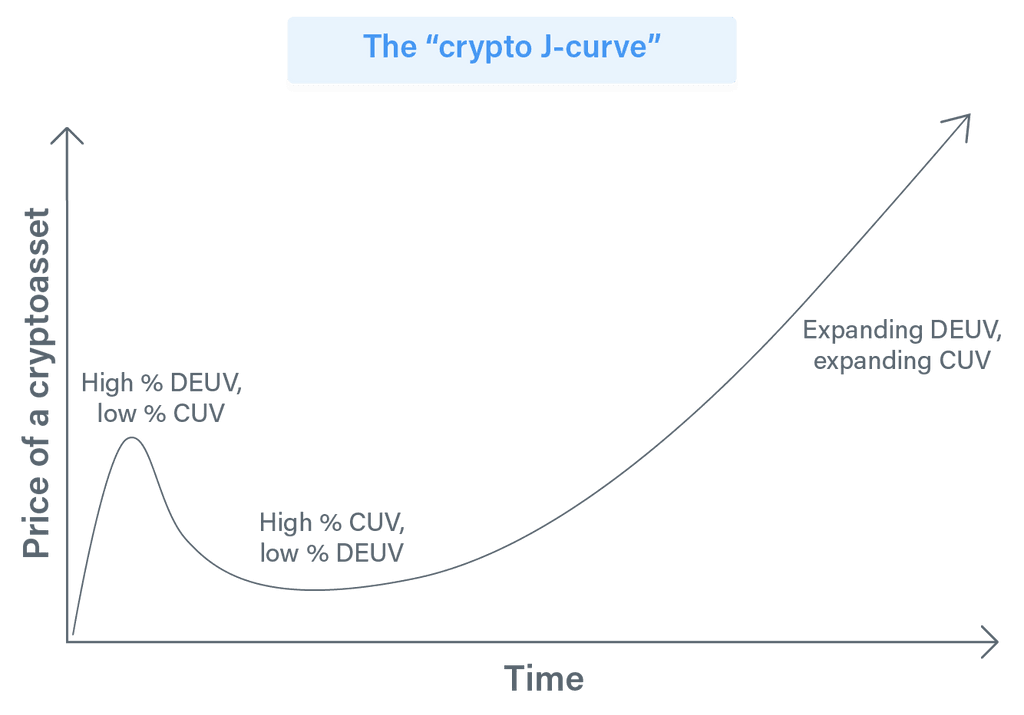
crypto J curve

The crypto J-curve models how the market values a cryptocurrency over time. Usually, upon an ICO, or its initial listing on a major exchange, enthusiasm for a crypto asset is high. It typically continues to moon (or boom) for a while. Yet, during this time, the utility value of the coin is usually minimal, or even non-existent.

As the coin gets utilised by others, potholes in the road appear, which the developers tried to patch up as quickly as possible. But enthusiasm wanes, and with that the value of the coin. However, as improvements are made to the protocol, things tick up again, drawing out a pattern in the shape of a ‘J’.

We introduced the equation of exchange in the post on crypto asset valuation. This model was conceived by Chris Burniske. However, he didn’t stop there and has extended the model further to form the ‘Crypto-J-curve’ hypothesis.

Let’s go into this step by step so that you can understand how market sentiment influences the value of your crypto assets.

Step 1: Utility Management

Burniske uses the discounted present value to measure the token utility. He assumes a specific maturity date, T, then proxies the token utility value by that date (in USD), finally discounting it back to today.

Readers should note that the utility measurement itself is futuristic. Future? Come again, Marty: In other words, if the token’s utility is considered immature today, we should consider its future utility and discount it back to get a fair valuation for its current price.

Step 2: CUV and DEUV, and What They Are

Burniske further decomposed the token price into ‘Current Utility Value’ (CUV) and ‘Discounted Expected Utility Value’ (DEUV).

The idea is that a token’s value consists of both:

  • the value as if it can be used today
  • the value as if it will be widely adopted in the future

The Crypto J-Curve in Action

Burniske believes that the enthusiasm for a crypto asset will initially be high and typically continues to grow for a while. In this period, the CUV of the asset is minimal, or non-existent if there’s no protocol. The asset is then largely composed of DEUV.

As the crypto assets progress through time, the enthusiasm may wane, weighing on the DEUV. Since the system is not yet mature, the CUV is low, and a high % of CUV presents a low valuation price.

The system will gradually mature with increased use, and the CUV of a crypto asset grows quietly. A growing CUV can occur even as the DEUV of the token continues to compress. If the market is bearish enough, the price of the asset may compress DEUV all the way to zero, leaving only CUV, and a drastically diminished price. Potentially, the market may even discount the asset to the point of trading below CUV, somewhat akin to a stock trading beneath book value.

The system will eventually reach a mature point where both CUV and DEUV are expanding, completing the whole market cycle.

Although the valuation model and the Crypto-J-curve provides a practical framework for analysing crypto assets, we would like to point out some problems and concerns with the model:

1. Arbitrary maturity date chosen

In Burniske’s example, he has used 30 years as maturity date. What if the token is more short or mid term focused? With a high discount rate (e.g. 30%), picking 10 years vs 30 years can significantly affect the result due to discounting.

2. Only single use case are allowed

Burniske assumed only one use case in his example. What if the token has more than one utility or use case?

3. It is hard to measure utility value in USD

Many arbitrary assumptions were introduced, including target addressable market and adoption curve.

4. An arbitrary discount rate

The discount rate has significant impact on the discounted utility, yet no sound methodology for calculating the discount rate is provided. Burniske subjectively picks 30% as the discount rate in his example.

5. Technological soundness is not considered

No factors are considering the technological soundness/platform and team capabilities.

6. The probability of failure

Projects may fail due to technology, execution, accidents, etc.

Is the Crypto J Curve Useful?

To conclude, Burniske provided one of the first crypto asset valuation models, which may provide directional insights for token valuation. It won’t give you a good estimate for exact token prices, but it has use as as a general roadmap for a token’s development.

How to Fully Understand the Value of Your Crypto

This post on the Crypto J-Curve completes a four-part series we created on cryptoasset valuation. You can also learn the 101 of crypto valuation, TradFi asset valuation tools, and other cryptoasset valuation models in the other pieces of our series for a deep dive and DYOR (do your own research) on what your crypto is really worth.

Monday, October 25, 2021

Meme Coins

Dogecoin, the first meme-coin, launched in 2013, was once considered an ironic gimmick and has now gained quite a reputation, becoming the 10th largest cryptocurrency with a $32.54 billion market capital on October 19, according to CoinMarketCap.

However, the pioneering meme currency has faced stiff competition from Shiba Inu and other floki-themed coins. So what's the fuss about these new floki coins? But first, let's understand what meme coins are.

Meme coins are cryptocurrencies, inspired by popular social media jokes, sarcasms and puns.

Currently there are about 124 meme coins, according to the Coinmarketcap website. Dogecoin's success in 2021 burgeoned the birth of many more meme coins imitating Doge.

* Meme coins are created with no specific use or inherent value, to gain quick high profits. In comparison, mainstream cryptocurrencies like Bitcoin are created with specific technology to boost trading and transactions in the crypto market.

* They are way more volatile than other cryptocurrencies as whales can lead to sudden rise and fall in their prices.

* For instance, Shiba Inu rose 230 per cent in 7 days following the sale of 6.3 trillion Shib tokens in the first 2 days of October.

* Their performance and fame are mostly linked with social media support and hype created by their influencers and they are highly community-driven.

* Many meme coins have unlimited stock that have a long-term impact on their prices.

* These coins are launched quickly, meaning they can be lost in the long term.

* According to the CoinMarketCap website, DogelonMars, MonaCoin and HogeFinance are among the top 10 cryptocurrencies in terms of market capital after Dogecoin and Shiba Inu on October 19.

Floki-themed cryptocurrencies

Floki- themed cryptocurrencies are dog-meme coins with the name Floki created after Elon Musk tweeted to name his Shiba Inu dog Flokifrunk on June 25. Some of the floki-themed coins include Shiba Floki, Floki Shiba, Flokinomics, Floki Inu and Baby Floki Inu.

Dogecoin-killer

Shiba Inu was launched in 2020 as a self-proclaimed killer of Dogecoin and aims to become an Ethereum-based substitute of Doge.

* Shiba Inu was created by a pseudonymous founder Ryoshi Inu.

* The meme coin was created to capitalize on the soaring popularity of the leading Dogecoin.

* The meme-coin has the second highest market capital of $11.12 billion after Dogecoin on October 19, according to CoinMarketCsp.

* It has three tokens namely Leash, Bone and Shib and it's retail demand has increased since the initial listing.

Shiba Inu was recently listed on India's oldest crypto exchange ZebPay on October 13 for trading and investing.

The triggering effect of the tweets

Though tweets are not meant to be taken as a price determinant for cryptos, Musk's tweets have been seen to trigger the prices of the meme coins since the Dogecoin days.

* The very famous tweet of sending SpaceX satellite Doge-1 to the moon on May 10, 2021 helped gain Dogecoin billions of dollars.

* Musk's tweet on May 19 2021– 'How much is that Dogecoin on the window'-- almost doubled the price of Dogecoin from $ 0.29 to $0.40 and Bitcoin fell below $40, 000 on the same day following the frantic sale of Doge.

* Musk's September 13 tweet 'Floki has arrived' with the pic of his Shiba Inu puppy, surged the price of Shiba Floki coins to nearly 958.9 and Floki Inu rose 60 per cent in 24 hours.

* The recent tweet on October 4, with a picture of Musk's puppy Floki on the hood of his Tesla car shot up the prices of Shib coins to 55 per cent and 22.13 per cent increase in Floki Inu's price.

Shiba Inu Coin (SHIB)

 Shiba inu (SHIB) is an Ethereum-based ERC-20 token that has risen in popularity this year, largely because of its dog-themed ecosystem, speculation on its price by retail investors and strong community engagement. The official Shib Twitter account, for example, has over 1.2 million followers – more than leading crypto companies such as Cardano, Kraken and Solana.

The digital asset was inspired by the Japanese breed of dog of the same name, which sparked a viral meme trend in 2013 and subsequently led to the creation of the infamous dogecoin cryptocurrency. Shiba inu, along with dogecoin and the hundreds of other pet-inspired digital assets, have become collectively known in the industry as “meme coins.”

Ordinarily, a meme coin offers owners little to no utility compared with more established cryptocurrencies such as bitcoin and ether. In the case of shiba inu, however, there seems to be a legitimate attempt by the development team to provide more value to SHIB holders, including launching a decentralized exchange in July.

Notably, the desire to provide more utility to users has seen the self-proclaimed “doge killer” become the second-most popular meme coin in the market. And although the market capitalization of dogecoin is three times that of shiba inu at press time, the underdog project has managed to create and build up a large community in less than two years.

Key features of shiba inu

So other than being another doggy-themed cryptocurrency, what is the shib coin all about?

The first notable thing about Shiba Inu is its total supply. A total of 1 quadrillion SHIB tokens were minted during its official launch in 2020. A quadrillion is a number followed by 15 zeros. Some 50% of the supply of shiba inu was locked in Uniswap SHIB/ETH liquidity pool – a decentralized exchange where users deposit pairs of assets into liquidity pools that other investors can trade against. That is known as an automated market maker system.

The other 50% of shib token’s supply was donated to Ethereum’s founder, Vitalik Buterin, who burned a vast majority of them by sending the tokens to a dead crypto wallet address. The remaining tokens (worth $1.2 billion at the time) were donated to an Indian COVID-19 relief cause and other charities.

The Shiba Inu universe also consists of a decentralized exchange, called Shibaswap, and two other tokens, “LEASH” and “BONE,”

Finally, the community is also championing a rescue campaign for Shiba Inu dogs. All you need to do is make purchases on Amazon through smile.amazon.com and select Shiba Inu Rescue Association (a 501(c)3 as your preferred nongovernmental organization). This will allow a percentage of your purchase to be donated to a cause focusing on helping Shiba Inu dogs in need.

Thursday, October 21, 2021

5分钟学投资 01 财务自由

 让你了解什么是财务自由

请订阅Youtube频道 https://www.youtube.com/channel/UCJy2siT-ElAOHiLuKeoCr2A 以观看每天更新全部周文强老师系列

Wednesday, October 20, 2021

What is NFT?


What is NFT?

NFT, or Non-Fungible Token, is a concept that is related to fungible tokens. If we compare it to the real world, fungible tokens are like currency: if you have $500 USD, you can divide it up, spend it in parts, get spare change, and continue to make more purchases with the change you receive. On the other hand, non-fungible tokens are unique and indivisible. Some examples could be: artworks, treasures in videogames, property deeds, or even certificates to prove wine provenance. When you trade a non-fungible token, you no longer own it, and since it is indivisible, there is no concept of spare change.

NFTs are issued on distributed ledgers on the blockchain. As such, as long as the ledger and the chain still exist, the record stating your NFT ownership will be intact. It will not be tampered with, removed, or disappear. When an NFT is issued, the contract will contain identifying information of the token including: the ID of the token, and a way to link to the assets it represents. These are the 2 main reasons why NFTs are optimal to prove a person’s ownership of an asset:

  1. The information is unalterable once it is on the blockchain
  2. NFT tokens are intrinsically unique, immutable, and indivisible

Similarly, NFT’s unique properties allow for it to be used in videogames to represent treasures or characters in the game. The most prominent example would be that of CryptoKitties. CryptoKitties is a blockchain game on Ethereum that allows players to buy, breed, collect and sell virtual cats. In the art world, NFTs can be applied to paintings, music copyrights, and various collectibles. A notable example would be encryption artist Beeple’s sale of their work: EVERYDAYS: THE FIRST 5000 DAYS, that was auctioned off for $69.34 million USD. NFTs are also commonly used in other industries in the form of digital certificates, identity authentication, and domain names.

So, how did the concept of NFTs come about? It started towards the end of 2017 when Dieter Shirley, CTO of CryptoKitties, released EIP-721 (Ethereum Implementation Proposal 721.) EIP-721 was different from ERC20 standard, which was very popular at the time and had highly sought-after ICO tokens. EIP-721 proposed, for the first time, tokens that were not interchangeable. Soon after, the concept of NFTs started to gain traction in different applications, including CryptoKitties. Nowadays, it is increasingly common to see NFT auctions hitting record numbers in the news.